ACL Prevention
Keys to Protecting Your Knee
An ACL prevention program can reduce your risk of ACL injury, and keep you off the sidelines. ACL injuries are possibly the most dreaded sports injury. Ask any high school or college athlete and they will tell you what they fear the most.
Prevention programs can be successful, but where do you start?
Why does the ACL get torn?
ACL tears occur when the knee gets into a postion that puts excessive stress
on the ligament. One of the most common ways an ACL injury happens is with
landing. Whether it is coming down from a rebound, jump stopping, or landing
after a block at the net, the amount of force that your body must absorb when
you land can wreak havoc on your knee.
In order for ACL prevention techniques to be effective, you must be able to
control the position of your knee when landing, changing directions, or stopping suddenly.
The key is for your body to react without you having to think about what kind
of position your knee is in. This is something that comes with training and
specific exercises designed to help prevent ACL injury.
Muscle Control vs. Strength
Many people believe that the key to ACL prevention is strength -
stronger muscles mean that your knee will be more stable. While this may be
true, it is only half of the equation for a successful prevention program.
More important than strength is muscle control. When muscles work in your body,
they are doing one of two things. They are either causing your joints to move,
or they are helping to stabilize and control your joints. Every single thing
you do throughout the day involves muscles working together to stabilize,
control, and move your body.
When an ACL tear occurs, the stabilizing or controlling muscles forget to
do their job - this puts your knee in a poor position and leads to an
overload of the ligament.
The key to a successful ACL prevention program is learning how to improve your
muscle control and stabilize your knee.
The "Danger Zone"
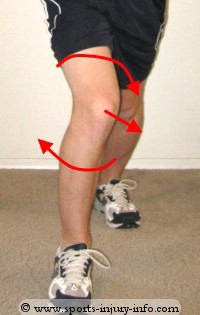
What is the danger zone?
This is the position of your knee that puts
your ACL at the most risk. It involves adduction and rotation of the femur towards
the middle of your body, and external rotation of the tibia.
To visualize this, stand
in front of a mirror with your feet about shoulder width apart. Now,
try to touch your knees together without moving your feet.
See how your knees feel like they want to collapse toward the middle
of your body? That is the danger zone, and is one of the most common
ways an ACL tear occurs.
Getting out of the "Danger Zone"
Keeping your knees out of the danger zone involves two things.
Number
one, you need to have strong core and hip muscles. Your outside hip
muscles (abductors, external rotators) are the muscles that pull your
knees away from the middle of your body. These are the muscles that
will help to keep you out of the danger zone.
The second thing you need is muscle control. When you jump, land,
and cut, you don't have time to think about where your knee is
positioned. So you need those muscles to be able to react and
control your knee without thinking about it.
Keys to ACL Prevention
The best way to prevent ACL tears is with a comprehensive program
that focuses on improving your hip strength, your muscle control
and muscle control, and that trains your body to react quickly and
automatically when your knee approaches the danger zone.
The good news is that with just a few exercises and a little
work, you can significantly reduce the chance of ACL injury.
A Complete Prevention Program
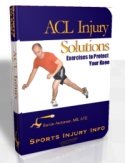
ACL Injury Solutions is a comprehensive 8 week program designed to help protect your ACL. It includes all of the best exercises for improving muscle control, balance, strength, and mobility. If you are recovering from an ACL tear, or want to prevent this dreaded injury, ACL Injury Solutions is for you.
Learn more about building strength for ACL Injury Recovery and PreventionLearn more about improving balance for ACL Injury Recovery and Prevention Didn't find what you were looking for? Search SII for more information...
Running Pain Solutions
Written for Runners by a runner, you'll learn a holistic approach to improving mobility, restoring normal movement and muscle activation patterns, and restoring the body and mind connection.
This Kindle Book contains a step by step program to keep you running pain free. Included are detailed instructions and illustrations for exercises to improve mobility, balance, neuromuscular control, strength and endurance. Only $7.49!
Get Your Copy Today!
Exercises to Improve Control and Balance
ACL Prevention ---> Return to Sports Injury Prevention