Hand Anatomy
They are seen most with sports that utilize the upper extremity, such as basketball, baseball, and softball. They are also common in contact sports such as football and rugby.
Wrist and Hand Bones
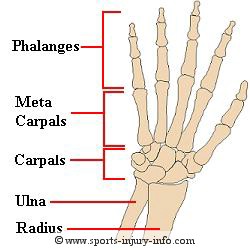
The hand is made up of two different sets of bones. The metacarpals and the phalanges. The metacarpals make up the hand, while the phalanges are your fingers and thumb.
The radius and ulna are the two bones that extend from the elbow into the wrist. The radius is on the thumb side, while the ulna is on the little finger side of the arm.
Wrist and Hand Ligaments
Another important part of hand and wrist anatomy is the ligaments. There are numerous ligaments throughout the wrist and hand. Each of the carpal bones is connected to its neighbor with a ligament.There are also ligaments along both sides of each of the fingers at all of the knuckles. In addition to the ligaments in the fingers, each finger joint has a joint capsule that encompasses the articulation between the phalanges.
Both the ligaments and the joint capsules can be injured, and you may hear this referred to as a "jammed finger".
Wrist and Hand Muscles
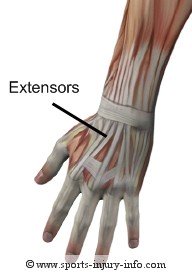
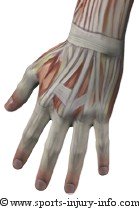
Some of the muscles that produce wrist flexion and extension start just below the elbow and attatch on the carpal bones.
Many other muscles are small, surrounding the fingers and palm, and help with bending and straightening your fingers and thumb. Because there are so many muscles, we will not name all of them.
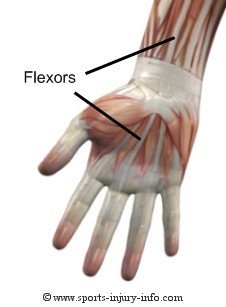
All of the muscles, bones, and ligaments work together to keep your hands working just right.
With an
understanding of wrist and hand anatomy, you can help prevent and treat
your sports injuries.
Didn't find what you were looking for? Search SII for more information...
Running Pain Solutions

Written for Runners by a runner, you'll learn a holistic approach to improving mobility, restoring normal movement and muscle activation patterns, and restoring the body and mind connection.
This Kindle Book contains a step by step program to keep you running pain free. Included are detailed instructions and illustrations for exercises to improve mobility, balance, neuromuscular control, strength and endurance. Only $7.49!
Get Your Copy Today!