Your Hip Flexor Injury
Hip flexor injury is very common in sports, especially soccer, football, and running. Caused by explosive movements, injury to these muscles can be painful, and cause all kinds of problems.Treating your hip flexor injury centers around understanding hip anatomy, and proper intial care, as well as focusing on improving your strength and flexibility.
The Hip Flexors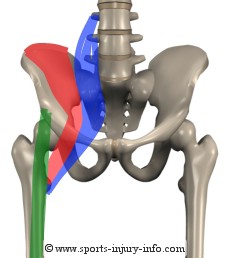
The hip flexors
are made up of three different muscles. The Rectus
Femoris, Psoas
Major, and Illiacus.
These muscles work together to help flex the hip,
and to provide stability for the lower extremity.The Rectus Femoris is one of the quadriceps muscles, and also helps with knee extension. The illiopsoas group runs from the lower spine and pelvis to the femur.
These muscles can be strained during activities, and can cause pain and loss of motion at the hip.
Causes
The most common cause of hip flexor injury is acute trauma. You may experience one specific instance when you felt your hip flexor pull. This may have been when you broke into a sprint, made a cut, or kicked a ball.Tight muscles and poor flexibility will contribute to hip flexor injury. When muscles are tight, there is an increased amount of tension on the tissues. When this increased tension is added to by an explosive movement, injury can occur.
Hip flexor strain can also be caused by compensation for other injuries, or weakness of other muscles. This is common if you have core weakness. When the lower abdominal muscles do not stabilize the pelvis, the hip flexor muscles will try to compensate for this weakness and become overworked.
Symptoms
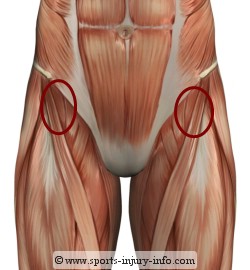
Running, jumping, and even walking can be painful, and your sports performance may be limited.
You may have a small amount of swelling, but this is not very common. Muscle spasm and bruising may also occur, depending on how severe the injury is.
Treatment
If you have suffered a hip flexor strain, you should see your family doctor to determine exactly what is wrong. Initial care should focus on rest, and the use of ice to control the inflammation.Ice massage or ice packs work well for this injury. Once your pain begins to subside, after a few days, you can begin gentle stretching of the hip flexors.
Prevention
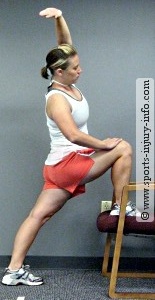
Preventing hip flexor injury focuses on good flexibility, as well as making sure you warm up before you go full speed. Warm muscles are much less likely to be injured. So take the time to warm up and start slowly before you go all out. A good flexibility program will also help to reduce the tension on the muscles, and reduce your likelihood for injury.Hip Flexor Solutions
Hip flexor injuries have a tendency to become chronic. This is because the rehabilitation often fails to address the underlying causes of the injury.In order to completely recover from a hip flexor injury, you must address the mobility,
flexibility, balance, and strength issues that led to your injury. Otherwise, you are
doomed to suffer a recurrence.
Hip Flexor Solutions is a complete program designed to put your body back into balance,
and to address all of the underlying mobility, flexibility, balance and strength deficits.
This program not only will treat your hip flexor injury and reduce your risks for re-injury,
it will also enhance your sports performance. A balanced body is a stronger body,
and Hip Flexor Solutions can give you both!
Learn More about Hip Flexor Solutions
Summary
Hip flexor injury can involve any or all of the three hip flexor muscles. It can occur with explosive movements, or gradually over time. Initial treatment should focus on rest and the R.I.C.E Principles, as well as seeing your family doctor. A good flexibility program and proper warm up is the best way to work to prevent this injury.Didn't find what you were looking for? Search SII for more information...
Running Pain Solutions
Written for Runners by a runner, you'll learn a holistic approach to improving mobility, restoring normal movement and muscle activation patterns, and restoring the body and mind connection.
This Kindle Book contains a step by step program to keep you running pain free. Included are detailed instructions and illustrations for exercises to improve mobility, balance, neuromuscular control, strength and endurance. Only $7.49!
Get Your Copy Today!