![]() |
||
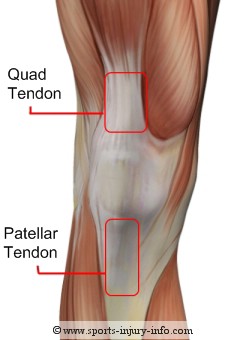
Knee TendonsThe knee tendons play an important role in knee anatomy, connecting the muscles of the leg to the bones. There are many different tendons around the knee, but the patellar tendon, quadriceps tendon, illiotibial band, and the hamstring tendons are the most commonly injured, and the ones we will discuss in more detail. Quadriceps Tendon The
quadriceps tendon attaches the four quadriceps muscles to the patella
just above the knee. The vastus lateralis, vastus medialis, vastus
intermedius, and rectus femoris are the four quadriceps muscles. The
work to extend the knee during activities. The quadriceps tendon is one
of several tendons that can be susceptible to tendonitis.Patellar TendonThe patellar tendon attaches the patella to the tibia via the tibial tubercle. Because it runs between two bones, it is sometimes referred to as the patellar ligament. It effectively completes the attachment of the quadriceps to the lower leg. The patellar tendon is much thinner than the quadriceps tendon, averaging about 30mm wide. Patellar tendonitis is an extremly common injury in sports.Illiotibial Band The
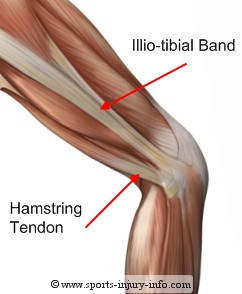
illiotibial band is a very long tendon, attaching the tensor faciia
latte muscle to the knee. The TFL is a hip abductior, and helps to
provide some medial rotation of the tibia. The IT band attaches on both
the fibula and the tibia on the lateral side of the knee. As the knee
flexes and extends, the illiotibial band moves over the head of the
fibula. If this knee tendon is tight, it can cause irritation and
inflammation at its insertion. This knee injury is known as IT band
friction syndrome.Hamstring TendonsThe hamstrings are the primary knee flexors, and they run along the posterior side of the thigh. These knee tendons attach to the tibia and the fibula along the medial and lateral sides of the knee. Hamstring tendonitis is a common knee injury with sports.SummaryThe knee tendons are vital for normal function of the knee and lower extremity. The provide a connection for the muscles to the bones. They are also very susceptible to knee injury, and tendonitis is one of the more common sports injuries.Knee Tendons ---> Return to Knee Anatomy Keeping You Off The Sidelines... |
More Anatomy InformationAnkle Anatomy Elbow Anatomy Foot Anatomy Hip Anatomy Knee Anatomy Shoulder Anatomy Wrist/Hand Anatomy EbooksAnkle Sprain SolutionsYour complete guide to treating your ankle sprain...![]() Only $14.95!
|
|
|
|
||
|
Home | Whats New | Newsletter | Disclaimer | Contact SII © 2004-2008 Sports Injury Info, All Rights Reserved Information on this site is for educational purposes only |
||

The
quadriceps tendon attaches the four quadriceps muscles to the patella
just above the knee. The vastus lateralis, vastus medialis, vastus
intermedius, and rectus femoris are the four quadriceps muscles. The
work to extend the knee during activities. The quadriceps tendon is one
of several tendons that can be susceptible to
The
illiotibial band is a very long tendon, attaching the tensor faciia
latte muscle to the knee. The TFL is a hip abductior, and helps to
provide some medial rotation of the tibia. The IT band attaches on both
the fibula and the tibia on the lateral side of the knee. As the knee
flexes and extends, the illiotibial band moves over the head of the
fibula. If this knee tendon is tight, it can cause irritation and
inflammation at its insertion. This knee injury is known as IT band
friction syndrome.