Hamstring Injury
Hamstring injury, sometimes referred to as a pulled hamstring, is extremely common in sports. It can often be a nagging injury, with a very high recurrence rate among athletes.
What causes a hamstring strain? What can you do to prevent it? Read on to find out more...
The Hamstrings
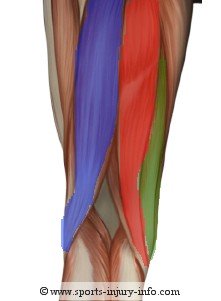
The hamstring muscles are found on the back of the thigh, just below the hips. There are four hamstring muscles, the semitendinosus, semimembranosus, and biceps femoris.
They all originate off of the ischial tuberosity and extend into the knee. The biceps femoris attaches on the lateral side of the leg, while the semitendinosus and semimembranosus attach on the medial side.
The hamstrings are responsible for flexing the knee, and also help extend the hip. They also play a role in stabilizing the knee during activities.
What Causes a Hamstring Injury?
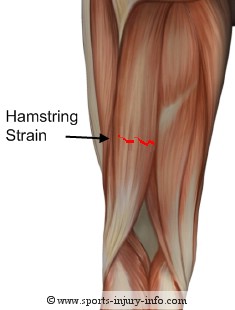
The injury is usually graded on a scale of 1-3, just like all muscle strains with 1 being the least severe, and 3 being the worst.
There are many factors that will contribute to hamstring injury, including flexibility, proper mechanics, strength balances, and sports activities.
Learn more about a pulled hamstring and the major causes and treatments.
Treatment
As with most sports injuries, treating a hamstring strain initially involves the R.I.C.E. principles. This will help to reduce pain and swelling, and protect the injured muscle.After the initial inflammation period, you can usually start gentle stretching to help reduce motion loss and to improve the muscle function. However, you do not want to stretch to the point of extreme pain.
As the muscle begins to heal, it fills in the tear with scar tissue. This new tissue is not as elastic or strong as the original fibers, and may be one of the reasons that hamstring strains are often recurrent injuries. This scar tissue is more susceptible to injury than the original tissue.
Rehabilitation is
very
important after a hamstring strain, as you must restore both normal
range of motion as well as strength. And it is important to make sure
that you limit scar formation. This can only be done by a trained
rehabilitation professional, and often involves massage and soft tissue
mobilization.
It is also important to consider any
biomechanical
factors that may have led to the injury in the first place. Were the
hamstrings very tight, or are there mobility issues in the hips or low
back. These can all be factors that contribute to injury, and unless
they are addressed, the hamstring injury will most likely occur again.Learn more about Hamstring Treatment and Rehab
Prevention
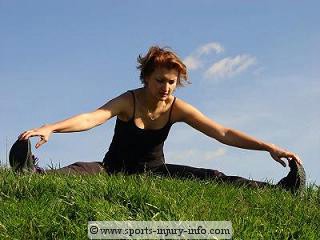
Proper strengthening of the muscles, and making sure they are balanced with the quadriceps is also important. Mobility of the hips and low back should also be addressed to help decrease the stress on the hamstring muscles.
A Complete Prevention and Treatment Program
In order to completely recover from a hamstring injury, you must address the mobility, flexibility, balance, and strength issues that led to your injury. Otherwise, you are doomed to suffer a recurrence.
Hamstring Solutions is a complete program designed to put your body back into balance, and to address all of the underlying mobility, flexibility, balance and strength deficits. This program not only will treat your hamstring injury and reduce your risks for re-injury, it will also enhance your sports performance. A balanced body is a stronger body, and Hamstring Solutions can give you both!
Learn More
Summary
Hamstring injury is very common, and can become a nagging problem if it isn't treated correctly. Rest, ice, compression, and elevation are important initially, and some type of rehabilitation to restore flexibility, strength, and endurance is essential. Proper warm up and stretching before activities, as well as making sure you have good muscle balance and mobility can help prevent this injury.Didn't find what you were looking for? Search SII for more information...
Running Pain Solutions
Written for Runners by a runner, you'll learn a holistic approach to improving mobility, restoring normal movement and muscle activation patterns, and restoring the body and mind connection.
This Kindle Book contains a step by step program to keep you running pain free. Included are detailed instructions and illustrations for exercises to improve mobility, balance, neuromuscular control, strength and endurance. Only $7.49!
Get Your Copy Today!