What Is A Rotator Cuff Tear...
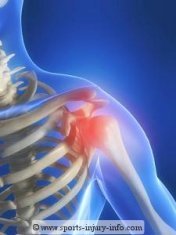
And How Do You Fix It?
While not the most common shoulder sports injury, a rotator cuff tear can be a very limiting. With causes ranging from overuse to traumatic injury, you can tear your rotator cuff in many different sports and activities.Overhead throwing activities are the most common sports associated with rotator cuff injury, however, tennis, football, swimming, and other upper body activities can also contribute.
Understanding how your rotator cuff injury occurs, common causes, appropriate treatments, and prevention can all help to keep you off the sidelines.
What is the Rotator Cuff?
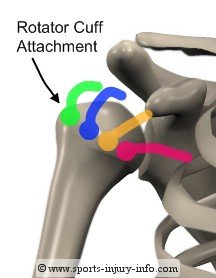
All four muscles must work together, contracting and relaxing in syncronization in order to produce a stable shoulder.
The four rotator cuff muscles include the subscapularis, supraspinatus, infraspinatus, and teres minor.
More information about shoulder anatomy
What is a Rotator Cuff Tear?
It is a disruption of the rotator cuff tendons, usually around their attachments on the humerus. The most common cuff muscle involved is the supraspinatus, followed by the infraspinatus.Tears can range in size from several millimeters to 1-3 centimeters. They can also be classified as either full thickness or partial thickness tears. This refers to how deep the tear is, and whether it goes all the way through your tendon from top to bottom.
What Causes A Rotator Cuff Tear?
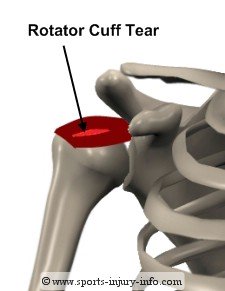
Many who suffer a rotator cuff injury have had previous shoulder injury, and may have suffered from shoulder impingement syndrome symptoms. The repetitive stresses placed on the shoulder cause a gradual tearing of the rotator cuff, which worsens with activity. Overuse tears may take several years to cause pain and discomfort.
Traumatic injury can also cause a tear of your rotator cuff. Falling on an outstretched arm can place significant stress on the soft tissue of your shoulder, and may lead to a torn rotator cuff.
Structural anatomy can also contribute to the prevelance of rotator cuff injury. If you have a large or hooked acromion, you may be more susceptible to rotator cuff injury.
Symptoms of a Rotator Cuff Tear
An atraumatic rotator cuff injury has a gradual onset of pain and problems in your shoulder. It may begin as an achey feeling after activities, especially overhead activities. You may feel week, have a "dead arm", and movement of your arm above your shoulder may increase your pain. You may also have pain at night, especially when laying on the sore shoulder.A traumatic tear of the rotator cuff is caused by a specific injury, like falling on your arm, or throwing overhead. Traumatic tears are associated with immediate pain, feeling weakness in your shoulder when trying to lift your arm, and tenderness to the touch around the outside of your shoulder. Moving your arm above your shoulder will also increase your pain.
Rotator Cuff Tear Treatment
If you have a torn rotator cuff, the first line of treatment is to rest your arm, and to use ice. Pain, weakness, and loss of motion all warrant a visit to your family doctor or athletic trainer.Your physician or athletic trainer will perform an examination to determine if you have a rotator cuff tear. Depending on the results of the exam, other tests like an X-ray and MRI may be used. An MRI can be very helpful in determining how bad your injury is, and will help determine treatment options.
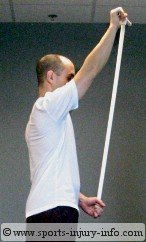
Stopping the activities that cause pain, and working on improving pain free ranges of motion and strengthening of the shoulder are the primary goals for rehab.
If you are suffering from nagging shoulder pain, you may be on your way to a rotator cuff tear. I see patients in my clinic who ignore their pain, or think that it will just go away, and six months later they are seeing me for rehab after surgery.
A simple set
of exercises designed specifically to strengthen
the rotator cuff is all they needed to avoid injury and ultimately
surgery. Had they sought treatment earlier, or been given a little
direction, they could have saved a lot of time, pain, and money.
As a practicing clinician, I believe in providing the highest
quality of care for my patients. I also know that many people do not
want to go to a clinic or their doctor for treatment. Thats why they
wait so long before finally coming in...and then it is too
late.
If you currently suffer from any of the following symptoms associated with rotator cuff pain, you may benefit from a rotator cuff training program...
- Decreased range of motion
- Inability to lay on the affected arm/shoulder
- Interrupted sleep or pain at night
- Weakness
- Difficulty or pain with getting dressed
- Pain with overhead reaching or throwing
- Pain with reaching behind your back
- Dull ache in the upper arm
While I highly recommend seeing your doctor for any of the
above symptoms, there are other options. "The
Ultimate Rotator Cuff Training Guide" could be the answer you
are looking for.
Preventing Rotator Cuff Tears
Prevention of a torn rotator cuff centers around proper strengthening and balance of the shoulder musculature. Limiting overhead activities to those that are pain free, and gradually increasing activities at the start of the season are also important.Flexibility, strength, and endurance of the shoulder can all help to prevent rotator cuff tears. A good training program that focuses on these areas could help you avoid surgery and continued pain.
Summary
Rotator cuff tears are not the most common shoulder sports injury, however, they can be very limiting. A good shoulder and upper back strengthening program, along with proper warm up and stretching can help to prevent rotator cuff injury.Limiting your overhead activities to those that are pain free, and seeking medical attention with any type of shoulder pain or impingement type symptoms is recommended. Treatment of rotator cuff tears is often successful with rehabilitation and rest, however, rotator cuff surgery may be necessary.
Didn't find what you were looking for? Search SII for more information...
Running Pain Solutions
Written for Runners by a runner, you'll learn a holistic approach to improving mobility, restoring normal movement and muscle activation patterns, and restoring the body and mind connection.
This Kindle Book contains a step by step program to keep you running pain free. Included are detailed instructions and illustrations for exercises to improve mobility, balance, neuromuscular control, strength and endurance. Only $7.49!
Get Your Copy Today!