What Are Concussions?

It is a mild traumatic injury to the brain usually caused by a blow to the head or from an acceleration or deceleration force.
How It Happens
A direct blow is a common way it happens. This involves either something hitting the head, or often with sports, the head hitting the ground.Your brain normally floats inside your skull, surrounded by cerebrospinal fluid (CSF). The CSF acts as a cushion to protect your brain tissue, as well as allowing it to remain centered within the skull.
A direct blow to your head can cause a sudden shift of your brain and the CSF, and depending on the severity of the blow, cause your brain to bump into the inside of your skull. Deceleration or acceleration forces can also cause this shift in the brain, resulting in a concussion.
Football is the sport in which they occur most frequently. It is usually due to rapid deceleration of your head, as your helmet helps to protect you from direct blows.
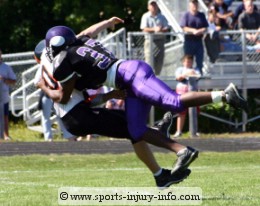
Do you remember the last time you saw a quarterback get sacked with a really hard hit? Think about how he was tackled.
His head whipped around as he went down to the ground. When this happened, his brain shifted, and may have led to a head injury.
Symptoms
Concussions are considered mild traumatic brain injuries. However, it is still not something to be taken lightly. What actually happens to your brain is a loss of normal mental function. This can mean confusion, trouble remembering how the injury happened, an inability to concentrate, headaches, fatigue, trouble sleeping, and ringing in the ears. Concussions
do not usually involve actual damage to the structure of the brain.
Despite this, symptoms can last for just a few minutes, or may persist
for days, weeks, or months.
One of the most important things to remember about concussions is that you do not
have to lose consciousness in order to have a concussion. In fact, the vast majority of
concussions never lose consciousness. Grades of Severity
There are numerous classification systems for concussions used by the medical profession. Many are rated on a scale of 1-3 or 1-5, and are based on loss of consciousness, and how long symptoms last.While grading can be helpful in determining the severity, the symptoms that are present are much more important for determining treatment options. As long as symptoms are present, even as minor as a headache, your athlete is still at risk if they return to sports. This means that regardless of what grade is given to a concussion, treatment and management is still determined by the symptoms that are present.
Treatment
They can be a very serious injury if not treated appropriately. Mild trauma to your brain can predispose you to further injury in the future. It is imperative that any head injury be evaluated by a medical professional. Evaluation involves specific cognitive tests to determine the extent of the injury.Along with the initial evaluation, periodic follow ups should be performed to make sure that the symptoms are not getting worse. Worsening of symptoms may indicate that there is a more serious injury, such as intercranial bleeding, or structural damage to the brain. Follow up examinations should be given every 24 hours for the first few days.
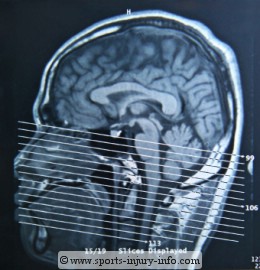
Aside from rest, there is little you can for concussions. You should stop activity until symptoms are no longer present. This includes sports, and may even include school attendence. Concussion experts recommend both physical and mental rest. Activities like schoolwork and reading can slow the recovery from a concussion. Injuries with symptoms lasting for more than a few hours should be evaluated in the hospital, and often warrant and MRI or CT scan to rule out any structural damage.
Returning to Play
You should only go back to activities once your symptoms have completely resolved, and a safe amount of time has passed. Your physician or athletic trainer should provide a progression for return to play. This involves slowly increasing activities and monitoring for a return of symptoms. Most guidelines recommend at least 7 days of continued rest from activities once symptoms are completely gone.This means that if you suffer a concussion on Friday night, and have a headache that continues until Monday, the earliest you should return to play
would be the following Monday. And that is only if you are completely symptom free at both rest and exertion. Many times symptoms will return when
you start to run or play. That indicates you are still suffering from concussion symptoms and it isn't safe to go back yet.
Multiple Concussions
After one, it is much easier to suffer another. Your brain is not completely back to normal, and often it takes much less force to cause injury than it did the first time. This is the reason that returning to play requires a complete resolution of symptoms, and a slow progression back to activities.Mis-treated concussions have the potential to be life threatening. Not only that, but post concussion syndrome can often be a major problem, affecting many aspects of your life outside of sports.
For more information on Concussions
Summary
The most important thing to remember is that they must be dealt with very seriously. You only get one brain, and you have to take care of it. Make sure that you see a doctor if you have a head injury, and follow their recommendations regarding treatment and when you go back to sports. It isn't just your athletic career you are dealing with, it is your life.Didn't find what you were looking for? Search SII for more information...
Running Pain Solutions
Written for Runners by a runner, you'll learn a holistic approach to improving mobility, restoring normal movement and muscle activation patterns, and restoring the body and mind connection.
This Kindle Book contains a step by step program to keep you running pain free. Included are detailed instructions and illustrations for exercises to improve mobility, balance, neuromuscular control, strength and endurance. Only $7.49!
Get Your Copy Today!